Dominant
theme investing has been my focus for the last several years starting with the “echo”
technology boom and then on to lumber and now aerospace. These sectors are
still in youthful secular bull phases.
Below
is the text I authored and published by the Toronto Star business on or about September
7, 2013.
----------------------------------------------------------------------
Traditionally
financial planners and investment advisors have embraced two basic rules when
advising clients on personal finance and equity investing
Never
get divorced, and never buy an airline stock.
The
never buy an airline stock rule is deep rooted and for good reason.
Investors
have long nightmare like memories when it comes to the North American airline
industry. In Canada we have
infamous names like Air Canada,
Wardair. Canadian Airlines, Zoom Airlines and Canada 3000. In the U.S. the list
is too long for this space.
Industry
experts have blamed the carnage on de-regulation, rising fuel costs, security
costs and various global crises such as the technology bubble of 2000 and the
financial crisis of 2008.
The
AMEX Airline index (XAL) which is designed to measure the performance of highly
capitalized companies in the commercial airline industry peaked in 2000 at the
160 level. By March 2009 the XAL was trading at the 16 level for a stunning
loss of 90 per cent,
The
dismal performance of the XAL is in sharp contrast to the success of the
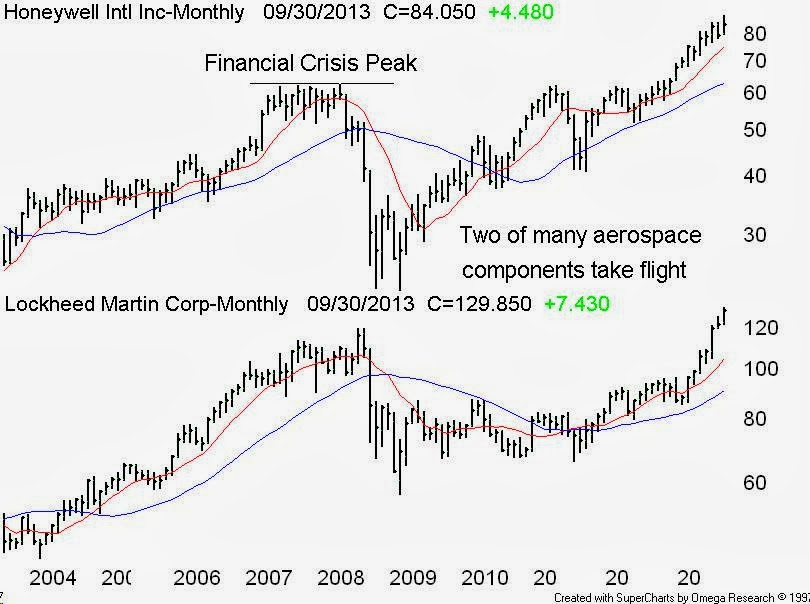
related commercial and defence manufactures and contractors. Names like he
Boeing Company (BA), Honeywell International Inc. (HON) and United Technologies
Corp. (UTX) are trading close to recent all-time highs.
Most
notable is the list of the top North American manufacturing employers. Names
like General Electric Company, General Motors Company, United Technologies
Corp, Ford Motor Co., The Boeing Company, Lockheed Martin Corporation and
Honeywell International Inc. are all related to trains, planes and automobiles,
The
common theme among most of these names appears to be related to aerospace and
made in North America.
Loosely
defined, aerospace is branch of technology and industry that is shared by three
major components, the defence industry, commercial aviation and space
exploitation programs such as spaceships and satellites.
Bullish
Investors in the aerospace sector have lately chosen to ignore that never buy
an airline stock rule. In the U.S.
the AMEX Airline index has soared 300 per cent from the March 2009 lows and
locally Air Canada
and WestJet Airlines Ltd, were among the top performers on the TSX in 2012.
According
to Standard & Poor's Capital IQ global air traffic trends are looking
positive. They claim the underlying drivers of the commercial aerospace
industry are improving global economic growth, an emerging global middle class
and the upgrade of an aging fleet of commercial aircraft.
The
commercial and defence manufactures are awash with orders from airlines
switching to new aircraft.
Some
recent Canadian examples would be WestJet Airlines Ltd (WJA) reaching a
preliminary agreement to purchase 65 737 MAX aircraft from Boeing Co (BA), and
Bombardier Inc. (BBD.B) recently signing a letter of intent to sell 50 Q400
NextGen turboprop aircraft to the Russian state-owned industrial and defence
conglomerate Rostec.
If
an investor embraces the aerospace theme he or she will need to seek out the
companies or investment products that will provide some exposure to the sector
In
other words we need to engage in stock picking or seek out sector related
exchange traded funds (ETFs).
At
the moment there appears to be no commercial airline industry ETFs that would
track the AMEX Airline index (XAL). Guggenheim Investments closed nine ETFs
back in March 2013 due to lack of investor interest. One of them was the
Guggenheim Airline ETF (FAA) which could be goods news to a contrarian
investor.
In
the U.S.
there are several ETFs that will provide direct exposure to all components of
the aerospace sector.
The
NYSE listed iShares Dow Jones US Aerospace & Defence ETF (ITA) tracks the
Dow Jones U.S. Select Aerospace & Defense Index. It has 33 holdings, to
include stocks like United Technologies Corporation (UTX), Boeing (BA),
Goodrich Corporation (GR) and Lockheed Martin (LMT).
Also
listed on the NYSE is the PowerShares Aerospace & Defence ETF (PPA) which
tracks the SPADE Defense Index. It has 51 holdings, to include Honeywell
International (HON), United Technologies Corporation (UTX), Lockheed Martin
(LMT) and Raytheon Corporation (RTN).
Here
in Canada
the ETF manufactures have avoided the space and so we have to engage in stock
picking.
Currently
there are only five TSX listed companies in the aerospace sector, CAE Inc.
(CAE), Magellan Aerospace Corporation (MAL), Bombardier Inc. (BBD.B),
MacDonald, Dettwiler and Associates Ltd. (MDA) and Héroux-Devtek Inc. (HRX)
Some
of these names may not be suitable investments and you may need the advice of a
fully licensed advisor before making an investment decision.


 Posts

